
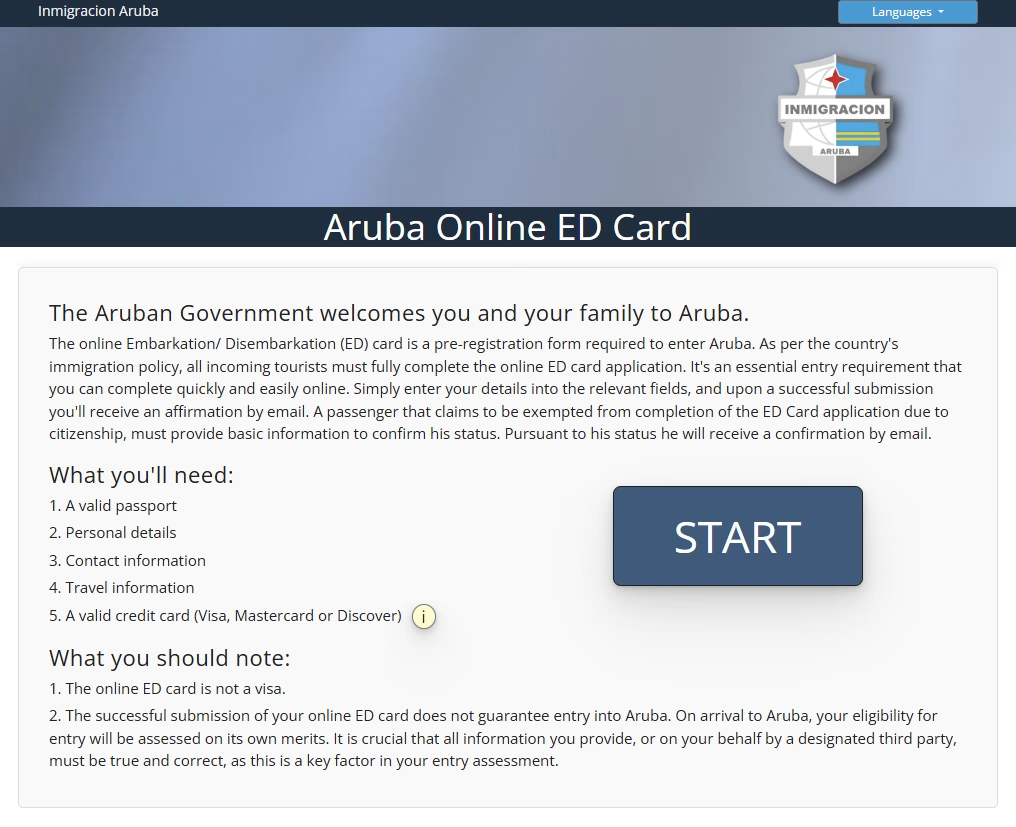
Short answer: every person flying to Aruba — including babies — must complete the online ED Card before departure. It is free, it takes about 10–15 minutes, it can only be submitted in the final days before travel, and the only official site is edcardaruba.aw. Without an approved ED Card you will not be allowed to board your flight.
Two things most guides get wrong, which are worth knowing before you read any further: most cruise passengers do not need an ED Card, and a large number of air travellers don’t pay the $20 Sustainability Fee at all — including anyone who visited Aruba within the past year and every child under 8. Both are covered in detail below.
Airlines check for the approved “qualifier” at check-in, and travellers do get turned away at the gate for not having one. Here’s exactly how it works, who’s exempt from the fee, and how to avoid the third-party sites charging up to $74 for a form the Aruban government provides for nothing.
What Is the Aruba ED Card?
ED stands for Embarkation–Disembarkation. It’s the digital replacement for the paper landing card that used to be handed out on the plane, and it has been a permanent part of Aruba’s immigration process since 2020. In October 2024 the government relaunched the platform with a cleaner interface and integrated fee payment, which is the version you’ll use today.
The form collects your personal details, passport information, contact details, flight or vessel information, and where you’re staying. Aruba’s immigration department uses it to pre-screen arrivals, which is why passport control at Queen Beatrix International Airport moves as quickly as it does.
Once your submission is approved you receive a qualifier — a document with a QR code. That QR code is scanned twice: once by your airline at check-in, and once by Aruban border control on arrival.
Who Needs One?
Everyone arriving by air. There are no age exemptions and no nationality exemptions for the card itself.
- Adults, children, infants and newborns each need their own ED Card
- Tourists, business travellers and people visiting family
- Returning residents and second-home owners
One ED Card covers one trip. Come back three months later and you submit a new one.
Cruise passengers: probably not
This is the single most misreported detail about the ED Card, and plenty of travel sites — including, until recently, this one — have got it wrong.
Cruise ship passengers usually do not need to complete an ED Card. According to Aruba Wastewater Sustainable Solutions, the body that administers the Sustainability Fee, the requirement applies only to passengers on vessels that are required to go through Aruba Immigration. For most standard Caribbean cruise itineraries, that isn’t the case, and passengers go ashore without completing anything.
Note that the deciding factor is the vessel, not whether you personally step off the ship. You can’t work this out yourself from your itinerary.
What to do: ask your cruise line directly whether your vessel’s passengers are required to clear Aruban immigration on arrival. They will know. Don’t assume either way, and don’t pay a third-party site to “process” a form you may not need.
The Submission Window: Don’t Get This Wrong
You can only submit in the final days before your travel date — official guidance points to roughly 6 days out, and you’ll see 7 days quoted widely too. Either way the window is short, and it trips up organised travellers constantly: you sit down six weeks ahead to get your paperwork done and the portal won’t accept you.
The practical advice:
- Set a calendar reminder for 5 days before departure. That sits safely inside the window on either reading of it, and leaves a buffer if something needs correcting.
- Don’t leave it to the airport. Approval is usually quick but is not guaranteed to be instant, and airport Wi-Fi plus a passport photo upload is a miserable combination.
- If your flight changes, you need a new ED Card. The old submission is tied to the old flight details and is no longer valid. This includes airline-initiated reschedules and rebookings after a cancellation.
- You won’t be charged the fee twice. If you already paid the Sustainability Fee and then have to resubmit, the system recognises your passport number and won’t bill you again.
The $20 Sustainability Fee
Since 1 July 2024, most visitors arriving by air also pay a $20 per person Sustainability Fee, charged at the end of the ED Card form and payable by credit card (Visa, Mastercard or Discover).
A few things worth knowing:
- The ED Card itself is free. The $20 is a separate charge collected through the same portal.
- It’s charged per traveller, not per booking — but see the exemptions below before you multiply by your party size.
- It funds wastewater and environmental work on the island, and is administered by Aruba Wastewater Sustainable Solutions (AWSS) rather than by the immigration department.
- There was a soft-launch period from 1 July to 6 December 2024 when payment was technically required but not strictly enforced. Since 6 December 2024 it has been fully mandatory for everyone who doesn’t qualify for an exemption.
Who doesn’t pay the $20 fee
This is the part almost every ED Card guide skips, and it’s worth real money to a lot of travellers. According to AWSS, the following are exempt:
- Children under the age of 8
- Repeat visitors returning within one year of their last visit
- Residents of Aruba
- Transit passengers in Aruba less than 24 hours under a transport agreement
- Travellers returning to Aruba under a transport agreement within one year
- Aircraft and vessel crew members on duty
Two of these matter enormously in practice.
If you’ve been to Aruba in the past twelve months, you almost certainly don’t pay. Since 7 July 2025, this exemption has been applied automatically — the system recognises your passport number during the ED Card process and simply doesn’t charge you. Aruba has a famously high repeat-visitor rate, so this affects a very large share of arrivals.
Children under 8 are free. So a family of two adults and two children aged 5 and 9 pays $60, not $80. Work out your actual total before budgeting.
One caveat on the automatic exemption: AWSS has acknowledged that problems migrating 2024 traveller data meant some repeat visitors who travelled in both 2024 and 2025 were charged when they shouldn’t have been. If that describes you, you may be eligible for a refund — but there’s a time limit, so don’t sit on it.
Refunds: assume you won’t get one
The fee is generally non-refundable. It stays paid even if your plans change, your trip is cancelled, you never use the QR code, or you change passports after paying.
Refunds are issued only in narrow technical circumstances — duplicate charges, or verified system errors that stopped you claiming an exemption you were entitled to, with documentation. They are not issued if you entered incorrect information, if you apply more than 60 days after travel, or if you ask for the money to go to a different credit card.
There is one additional discretionary route worth knowing: AWSS grants refunds to eligible medical travellers from within the Dutch Kingdom — the Netherlands, Curaçao, Sint Maarten, Bonaire, Saba and Sint Eustatius — on submission of supporting documentation after arrival, such as a referral, an insurer’s letter or an appointment confirmation. There’s also a separate advance-application exemption for native Aruban students studying abroad, which must be registered before travel.
If something goes wrong: the ED Card help line is +297 2808000, and AWSS can be reached at info@awss.aw.
Factor the fee into your planning alongside the rest of your costs — our complete Aruba vacation cost breakdown covers the full picture.
The Copycat Site Problem
Search “Aruba ED Card” and a significant share of the results are commercial services offering to fill in the form on your behalf. Their prices run from around $30 to $74 per traveller, on top of the $20 government fee.
These services are generally not scams in the criminal sense — they’ll usually submit a real application. But they’re charging a substantial fee to type your passport number into a free government website, and some of them are designed to look official enough that travellers believe they’re on a government page.
How to make sure you’re in the right place:
- The official portal is edcardaruba.aw. Note the
.aw— that’s Aruba’s country domain. - The official site never charges for the form itself. If you’re being asked for a “processing fee,” “service fee” or “priority processing” charge on top of the $20, you’re on a reseller.
- Aruba’s official tourism site (aruba.com) and the airport’s own site both link directly to the correct portal. When in doubt, navigate from one of those rather than from a search result.
If you’ve already paid a third party and the application went through, you’re fine — you just paid more than you needed to. Nothing is wrong with your entry.
How to Complete the Aruba ED Card: Step by Step
Set aside 15 minutes and have your passport, flight confirmation and accommodation address to hand.
Step 1 — Go to edcardaruba.aw. Confirm the domain before you type anything.
Step 2 — Start a new application. You can usually include several travellers in one submission, which is much faster for families. Each traveller still receives their own qualifier.
Step 3 — Enter passport details exactly as printed. Name, number, country of issue, expiry date. The single most common cause of a rejected or delayed application is a name that doesn’t match the passport — including middle names, hyphens and accents. Your passport should be valid for the duration of your stay; some airlines apply stricter validity rules of their own, so check with your carrier.
Step 4 — Upload your passport photo page if prompted. A clear, well-lit phone photo of the whole page is fine. Make sure all four corners are visible and nothing is cut off.
Step 5 — Enter your travel details. Airline, flight number, arrival date, departure date. Take these from your booking confirmation rather than memory.
Step 6 — Enter your accommodation address. The hotel name and address, or the full address of your rental. “Palm Beach” alone is not enough.
Step 7 — Pay the Sustainability Fee by credit card, if applicable to you.
Step 8 — Wait for approval and save your qualifier. Download the PDF, screenshot the QR code, and email it to yourself. Do not rely on having mobile data at the airport. If you’re travelling with family, keep every traveller’s qualifier accessible on one device as a backup.

What Happens When You Land
The arrival process at Queen Beatrix International Airport is efficient by Caribbean standards, largely because of the pre-screening the ED Card enables.
Immigration. Present your passport and your ED Card QR code. Officers may ask standard entry questions — length of stay, where you’re staying, purpose of visit. Have your accommodation name ready.
Baggage claim. Straightforward. Trolleys are generally available.
Customs. Aruba applies duty-free allowances on alcohol, tobacco and goods. Fresh produce, plants and certain meat products are restricted — leave the fruit from the plane on the plane. Declare cash above the reporting threshold.
Landside. Taxis operate at government-fixed rates with no meters — confirm the fare before you get in, and note there is no Uber or Lyft on the island. Car rental desks sit just outside arrivals. Our Complete Guide to Transportation in Aruba covers the options in detail, and the Aruba Transportation Costs Calculator will estimate your specific spend.
Getting connected. If you want a local SIM rather than roaming charges, both carriers have airport presence. We compared them in SETAR vs. Digicel Aruba.
Flying Home: The US Pre-Clearance Bonus
If you’re returning to the United States, Aruba has one of the best departure setups in the Caribbean: US Customs and Border Protection pre-clearance on the island. You clear US immigration and customs in Aruba before you board, and land in the US as a domestic arrival — no immigration queue, no customs hall, straight to baggage or your connection.
The catch is time. Pre-clearance adds a full processing layer to departure, so arrive at least three hours before a US-bound flight, and closer to four during high season. Travellers who show up at the standard two hours regularly find themselves sprinting. See our guide to the best airlines flying to Aruba for carrier-specific notes.
Common Mistakes to Avoid
- Submitting too early. Outside the window — around 6 to 7 days — the portal won’t take it.
- Name mismatches. Match the passport exactly, including middle names.
- Forgetting the kids. Infants need their own ED Card. Every time.
- Not resubmitting after a flight change. The old one is void.
- Relying on airport Wi-Fi. Save the QR code offline.
- Paying a third party unnecessarily. The government form is free.
- Cutting departure time fine on a US-bound flight. Pre-clearance takes time.
Frequently Asked Questions
Is the Aruba ED Card free? The ED Card itself is free. Most air arrivals also pay a separate $20 per-person Sustainability Fee through the same portal. Third-party services charging $30–$74 are optional resellers, not official.
How far in advance can I fill out the Aruba ED Card? Only in the final days before travel. Official guidance points to around 6 days out, though 7 is widely quoted. Earlier submissions are not accepted, so aim for about 5 days before departure.
Do children and babies need an ED Card? Yes. Every traveller of every age needs their own, regardless of nationality.
What happens if I forget my ED Card? Your airline will not board you. In practice, travellers end up completing it at the check-in desk on a phone, which is stressful and sometimes too late. Do it at home.
Do cruise passengers need an Aruba ED Card? Usually not. The requirement applies only to passengers on vessels that are required to clear Aruba Immigration, which is not the case for most standard cruise itineraries. It depends on the vessel rather than on whether you go ashore, so ask your cruise line to confirm.
Who is exempt from the $20 Sustainability Fee? Children under 8, repeat visitors returning within one year of their last trip, Aruba residents, on-duty crew, and certain transit and transport-agreement travellers. The repeat-visitor exemption has been applied automatically since July 2025.
I visited Aruba last year. Do I pay the fee again? Almost certainly not. If you’re re-entering within one year of your previous visit, the system should recognise your passport number and waive the charge automatically.
Is the Sustainability Fee refundable? Generally no — not for cancelled trips, changed plans or unused QR codes. Refunds are limited to duplicate charges and verified system errors, must be claimed within 60 days of travel, and must go back to the original card.
Is edcardaruba.aw the only official website? Yes. Anything else charging a service fee is a third-party reseller.
What if my flight is cancelled or rescheduled? Submit a new ED Card with the correct flight details. The original is tied to the old flight and is no longer valid.
How long does approval take? Usually quickly, often within minutes, but it isn’t guaranteed to be instant. Build in a day of buffer.
The Bottom Line
The Aruba ED Card is a genuinely simple piece of admin that causes an outsized amount of travel-day stress, entirely because of the 7-day window and the number of people who discover it at the airport.
Put a reminder in your calendar for five days before you fly. Use edcardaruba.aw and nothing else. Fill it in at your kitchen table with your passport in front of you, save the QR code to your phone and your email, and then forget about it.
Then get on with the interesting part of the planning — like deciding where on the island to stay and what a week in Aruba actually costs.
Share this content: